
Landing in Dubai, Colombo or Nairobi: how to stay connected on a trip from India
The UAE, Sri Lanka and Kenya are three of the easiest international trips to plan from India, and Indian travelers are a big part of all three. India was Sri Lanka's largest source market in 2025, with 531,511 of the…
The UAE, Sri Lanka and Kenya are three of the easiest international trips to plan from India, and Indian travelers are a big part of all three. India was Sri Lanka’s largest source market in 2025, with 531,511 of the island’s 2,362,521 arrivals (SLTDA, Year in Review 2025). Kenya counted 112,893 arrivals from India the same year (Tourism Research Institute, Annual Tourism Sector Performance Report 2025). And at Dubai International, “India retained its position as DXB’s largest country market with 11.9 million guests” (Dubai Airports).
What changes from one country to the next is how you get online when you land. The options are the same three everywhere: an international roaming pack from your Indian carrier, a local SIM bought on arrival, or a travel eSIM installed before you fly. The trade-offs are not the same, and each country has one rule that catches people out.
Two checks before you leave home
Can your phone take an eSIM, and is it unlocked? On iPhone, eSIM needs “an iPhone XS, iPhone XS Max, iPhone XR, or later” (Apple), and the iPhone Air sold in India is eSIM-only: “not compatible with physical SIM cards” (Apple India). Google says “Pixel 4 and later: All phones work with eSIM” (Google). Samsung India lists its eSIM models but warns that “depending on the country of origin, eSIM may not be supported even if your device is listed above” (Samsung India).
Whatever the brand, a second plan only works on an unlocked phone. Apple puts it plainly: “To use two carriers, your carrier must unlock your iPhone, or both plans must be from the same carrier” (Apple). On Pixel, “the phone must be SIM-unlocked” (Google).
Keep your Indian SIM in the phone. Your bank OTPs arrive by SMS on that number, and banking and UPI apps are tied to the SIM; the government describes SIM binding as “already standard in banking/UPI systems“. On a dual-SIM phone the setup that works is simple: your Indian SIM stays in for calls and SMS, and you switch mobile data to whatever you use abroad.
Check what your carrier charges to receive SMS while roaming. Jio says “all incoming text messages are free in international roaming (IR)” (Jio). Vi says “you need to recharge with Rs 118 or any other IR pack with service validity to receive incoming sms abroad” (Vi).
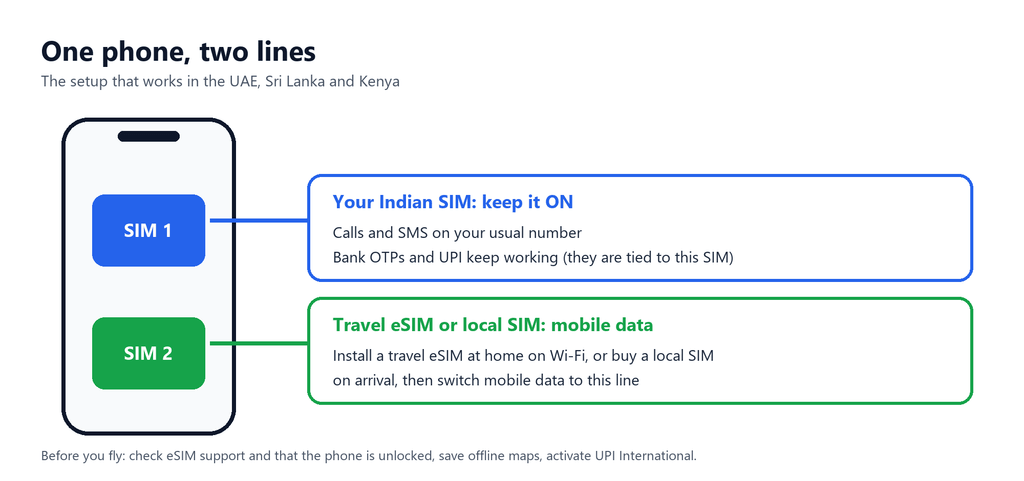
One phone, two lines: your Indian SIM stays on for calls, SMS and OTPs, and mobile data runs on the line you bought for the trip. Original illustration by PuraSIM.
United Arab Emirates
Calls are the first surprise. The UAE allows only approved internet-calling apps. Its telecoms regulator publishes a “list of VoIP applications that are currently allowed in the UAE”, with Microsoft Teams, Zoom, Google Meet for meetings, Webex, Slack, BOTIM and GoChat among them (TDRA), and warns that the operators “most probably will block your illegal traffic” (TDRA FAQs). As of this year, “WhatsApp voice and video calls remain blocked, including on web, mobile, and desktop clients” (Times of India). Messages work; calls don’t.
Don’t reach for a VPN to get round it. Under UAE cybercrime law “it is a serious offence to use a VPN for illegal purposes — including committing a crime or concealing one’s IP address to access websites, calling apps, or gaming platforms blocked by the UAE government” (Khaleej Times).
Local SIM. du hands out “free tourist SIMs at DXB’s immigration counters” (Dubai Airports). Etisalat’s (e&) Visitor Line is sold “with a valid passport and visa”.
Roaming from India. Jio’s UAE packs start at ₹898 for 7 days with 1 GB of data (Jio). Airtel’s ₹898 pack gives 2 GB for 5 days and covers 189 countries, the UAE among them (Airtel).
Travel eSIM. You install it at home on Wi-Fi and it connects when you land, with your Indian SIM still in the phone for OTPs. Several stores sell one; PuraSIM, which I run, has a UAE travel eSIM. When you compare them, look at the data allowance, the validity and which local network the plan uses.
Paying. UPI works at UAE merchants on its partner networks (Mashreq’s NeoPay, Network International and Magnati) and has been live there since April 2022. Before you fly, “activate the UPI Global/UPI International service for your specified bank account” in your UPI app (NPCI).
Sri Lanka
Indian visitors make the shortest trips of all: the SLTDA notes that India “has the shortest average duration among all listed countries, ranging from 4.3 days in August to 5.5 days in December” (SLTDA). On a four- or five-day trip, the option that gets you online fastest is worth more than saving a few rupees.
Local SIM at the airport. Dialog says that “right after the customs desk in the Arrival lobby, you’ll find two Dialog Airport Stores”, where you show your passport; its tourist plans start at LKR 1,399 for 20 GB (Dialog). SLTMobitel has counters in the arrival lobby at Bandaranaike International Airport, a 7-day tourist pack at LKR 821 with 15 GB, and an eSIM on request; “You only need your foreign passport” (SLTMobitel).
Roaming. Airtel’s multi-country packs include Sri Lanka (Airtel).
Paying. UPI has worked at Sri Lankan merchants through LankaPay since February 2024. Same rule: activate UPI International before you go.
Kenya
This is where roaming gets expensive. Jio publishes no data pack for Kenya. Without one, its standard rates for Kenya are ₹0.10 for every 10 KB of data and ₹10 a minute for local calls (Jio, IR Standard PayGo Rates). That works out to about ₹10 per MB, or roughly ₹10,000 for a single gigabyte. Airtel’s multi-country packs do cover Kenya (Airtel); check the pack before you land rather than after.
Local SIM. Safaricom asks you to “register with your identification document (National ID/ Passport)”. Its mobile money service, M-PESA, needs the same: “a mobile phone with a Safaricom SIM card and valid Identification document” (Safaricom). If you’d rather not register for M-PESA, the TouristTap app lets visitors pay M-PESA tills by card: it “supports any international Visa or Mastercard” (Tech-ish, April 2026).
Coverage. Safaricom reports “over 97 percent of the population covered by 2G, 3G, and 4G services” (SAMENA). That is population coverage, not coverage inside the national parks, so download offline maps before a safari.
Paying. Kenya is not on the government’s list of countries where UPI is live. Carry a card.
Which option, when
| Works best for | Watch out for | |
| Roaming pack | Short trips with no setup at all | Small data caps; in Kenya, Jio has no data pack |
| Local SIM | Longer stays and heavy data use | Passport registration and a queue on arrival |
| Travel eSIM | Landing already online, with your Indian SIM still active | The phone must support eSIM and be unlocked |
Whichever you choose, the setup that works in all three countries is the same: your Indian SIM stays in for OTPs and UPI, mobile data runs on the line you bought for the trip, and your maps are saved offline before you leave.
About the authorMarc González Sáez is the founder of PuraSIM (purasim.com), a travel eSIM store with more than 3,000 data plans across 187 countries, delivered instantly by QR. He works on it from Barcelona and writes about eSIM provisioning, travel connectivity and the things that break in between.
More from Trodly

The Complete Guide to Swiss Visa Applications for Indian Travelers
Switzerland is a popular destination for Indian tourists each year because of its stunning Alps and immaculate lakes. However, it is crucial…

11 Things to Keep in Mind While Travelling in India
India is a place like no other; it is a country but nothing less than a continent in itself. India is a…

The Art of Slow Travel: Embrace Spontaneity and Savor the Journey for a Meaningful Experience
Embrace the art of slow travel, where you prioritize savoring the journey over racing to destinations. This mindful approach enriches your experiences…